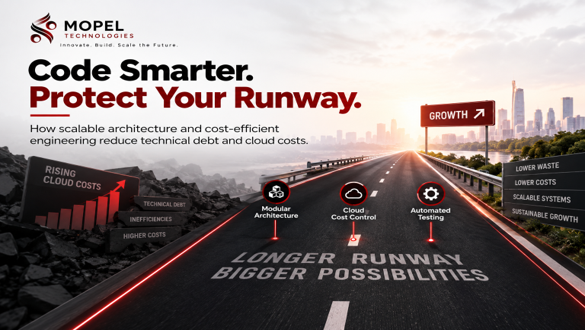

For early-stage startups, technology decisions are financial decisions. Every feature, API, database, and cloud service affects your development costs, cash flow, and startup runway.
The goal isn’t to build the most complex system or use the newest technology. It’s to build software that is reliable, scalable, and cost-efficient as the business grows.
Poor technical decisions can increase technical debt, cloud costs, maintenance work, and developer workload. Smart architecture helps control these costs while giving your team room to build and grow.
Technical Debt Has a Financial Cost
Technical debt happens when teams take shortcuts that create more work later.
Skipping tests, rushing fixes, or building without proper documentation may help you move faster initially. But over time, these shortcuts can increase development and maintenance costs.
Technical debt can lead to:
- Slower product releases
- More bugs and system failures
- Higher maintenance costs
- Security vulnerabilities
- Developer burnout
Lean software engineering isn’t about cutting corners. It’s about making practical decisions that balance speed, reliability, scalability, and cost.
3 Architecture Decisions That Protect Your Cash Flow
Early-stage teams don’t need overly complex architecture. They need systems that support current users, scale when demand increases, and avoid unnecessary costs.
Three areas deserve particular attention:
- Modular architecture — Make systems easier to maintain and change.
- Scalable cloud infrastructure — Match infrastructure costs to actual demand.
- Automated testing and CI/CD — Reduce manual work and catch problems earlier.
1. Use Modular Architecture
A tightly connected codebase makes every change riskier. A problem in one feature can affect other parts of the application.
Modular architecture separates major features into manageable components. This allows developers to update or replace individual parts without disrupting the entire system.
It also makes the codebase easier to maintain and allows different developers to work on specific areas more safely.
2. Scale Infrastructure With Your Business
Paying for infrastructure you don’t need can quickly increase your cloud costs.
Instead of provisioning large servers for future demand, use flexible infrastructure and auto-scaling where appropriate. Serverless services and scalable databases can help infrastructure adjust to actual usage.
Avoid:
- Paying for unused capacity
- Over-provisioning servers
- Building for millions of hypothetical users
Instead:
- Monitor cloud usage
- Scale infrastructure with demand
- Review infrastructure costs regularly
The goal is simple: pay for what you need and scale when your business grows.
3. Automate Testing and Deployment Early
Manual testing becomes increasingly expensive as a product grows. Developers can spend significant time checking existing features every time new code is released.
Automated testing helps identify problems earlier, while CI/CD can automate parts of the testing and deployment process.
This can help teams:
- Reduce repetitive manual work
- Release updates faster
- Catch bugs before production
- Spend more time on product development
You don’t need a complex CI/CD setup from day one. Start with the testing and deployment automation that provides the most value, then expand as your product grows.
Protect Your Engineering Team
Technical efficiency isn’t only about reducing cloud bills. It also affects how much your engineering team can accomplish.
A complex and poorly documented codebase can create:
- Difficult onboarding
- Developer bottlenecks
- More maintenance work
- Dependence on a few key developers
- Slower product development
Clear documentation and modular architecture make it easier for new engineers and contractors to contribute. Your team spends less time understanding existing problems and more time building useful product features.
Build for Sustainable Growth
The right architecture should support your business today without creating unnecessary costs tomorrow.
Investing early in modular architecture, scalable cloud infrastructure, automated testing, and CI/CD can help startups reduce technical debt and improve engineering efficiency.
Good technology leadership isn’t just about building software that works. It’s about building software that supports growth without consuming your runway.
Is Your Technology Working for Your Runway?
Your technology should help your business grow, not quietly increase your costs.
If you’re dealing with rising cloud costs, technical debt, slow development, or an architecture that is becoming difficult to scale, it may be time to take a closer look at your technology foundation.
Mopel Technologies can help you identify what’s slowing your team down, reduce unnecessary technology costs, and build a stronger foundation for sustainable growth.
Ready to build smarter? Get in touch with Mopel Technologies.